
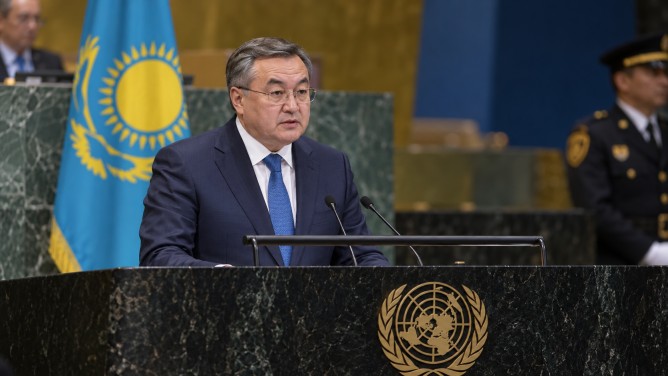
Kazakhstan has called for renewed diplomatic initiatives to tackle global conflicts and improve international cooperation, highlighting concerns over a growing deficit of trust worldwide. Addressing the United Nations General Assembly, Foreign Minister Mukhtar Tileuberdi emphasized the importance of resolving conflicts through diplomacy and negotiations, particularly in the context of the ongoing war in Ukraine.
Tileuberdi condemned drone attacks on Kazakhstan’s oil export infrastructure and commercial vessels in the Black Sea, warning that such actions could have severe implications for navigation, international trade, and global energy supplies. He urged nations to uphold international law and fulfill their commitments to restore global trust.
In discussing the Middle East, Tileuberdi reaffirmed Kazakhstan’s support for a two-state solution, advocating for an independent Palestinian state coexisting peacefully with Israel. He also expressed Kazakhstan’s willingness to contribute to Gaza’s stabilization through civilian reconstruction efforts, food security, and digital government services. Kazakhstan announced its intention to join the Abraham Accords, signaling a commitment to foster peace and cooperation in the region.
On Afghanistan, Tileuberdi emphasized the need for greater international engagement and assistance, linking the country’s stability to the security and development of Central Asia. He called for coordinated efforts through the United Nations, stressing that humanitarian aid should be coupled with long-term strategies to combat poverty, displacement, and economic dependency.
Highlighting Kazakhstan’s experience with nuclear disarmament, Tileuberdi renewed calls for progress in this area, offering to host high-level discussions among nuclear-armed states. He pointed out Kazakhstan’s historical decision to close the Semipalatinsk nuclear test site and relinquish its inherited nuclear arsenal, urging nuclear powers to pursue disarmament despite existing disagreements.
Tileuberdi also advocated for greater representation of Asia, Africa, Latin America, developing countries, and middle powers in the UN Security Council. During the General Assembly, he engaged in discussions with UN officials and foreign ministers on topics including UN reform, regional connectivity, energy, investment, and transport, with a focus on sustainable development in Central Asia and Afghanistan.