
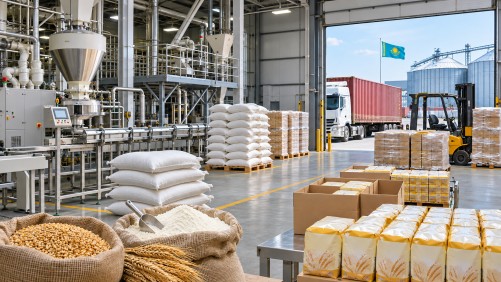
Kazakhstan’s processed agricultural exports have surged by 35% to reach $3.4 billion, highlighting an increasing global demand for the country’s value-added food and agricultural products. This growth also pushed the share of processed goods in Kazakhstan’s total agricultural exports from 51.3% to 53.3%, signifying a shift towards more lucrative domestic processing.
Aidarbek Saparov, Kazakhstan’s Agriculture Minister, emphasized that the expansion of production and export of processed agricultural products is a top government priority. He pointed out that domestic processing of raw agricultural materials provides higher economic benefits compared to exporting unprocessed grain.
Kazakhstan’s agricultural sector produces significant quantities of wheat and corn, with annual outputs of approximately 18–20 million tonnes of wheat and 1–1.2 million tonnes of corn. This year’s corn harvest reached a notable 1.7 million tonnes, presenting further opportunities for the country’s food-processing industry.
Currently, Kazakhstan processes over 5 million tonnes of grain annually, including around 510,000 tonnes through advanced deep-processing technologies. In a related development, the country produced 145,100 tonnes of starch products in 2025, marking a 21.8% increase from the previous year. Bioethanol production saw a significant rise as well, doubling year-on-year to 21,000 tonnes.
Looking ahead, the Agriculture Ministry plans to establish six major wheat and corn processing facilities by 2029. These new projects are expected to collectively process 5.8 million tonnes of raw agricultural materials annually, further strengthening Kazakhstan’s agricultural processing industry.
The expansion aims not only to boost exports of finished products but also to enhance the economic value derived from Kazakhstan’s domestic agricultural resources, reinforcing the country’s position in the global agricultural market.